Saturday is October 31, the last day this year that the US-31 bascule bridge runs on its summer clock. Starting Sunday, the half-hour rhythm that shapes every drive down Bridge Street goes away until April. When it returns next spring, the Michigan Department of Transportation plans to start a $2 million project to reorganize the street around it. The project adds new traffic signals at Antrim Street, Mason Street and Park Avenue, makes two side streets one-way and moves two crosswalks people have used for years.
The bridge and the plan are one story. MDOT can't change when the bridge goes up. Everything in the 2027 plan works around that fixed schedule by creating predictable times to move between bridge lifts.
A schedule set by federal rule
The bridge schedule comes from a federal regulation. 33 CFR 117.641, the Coast Guard's rule for the Pine River channel at Charlevoix, sets when the draw opens. From April 1 through October 31, between 6 a.m. and 10 p.m., the bridge only has to open for recreational boats from three minutes before to three minutes after each hour and half-hour. Commercial vessels, public safety boats, boats in distress and boats seeking shelter from severe weather go through as soon as possible, at any hour.
The rest of the year works differently:
| Period | How the draw operates |
|---|---|
| April 1 to October 31, 6 a.m. to 10 p.m. | Recreational boats pass in windows around the hour and half-hour |
| April 1 to October 31, overnight | Opens on signal |
| November 1 to December 31 | Opens on signal |
| January 1 to March 31 | Opens on signal with at least 12 hours' advance notice |
MDOT's project FAQ answers a question many people asked: why not limit openings to once an hour and make boats wait? Under federal law, boats have the right of way on most navigable waterways, so the Coast Guard sets the schedule, not MDOT. The twice-hourly daytime openings used to be required year-round. Then MDOT asked the Coast Guard for a change, which was published in the Federal Register in March 2000 and limited them to the April-through-October season. The bridge itself opened in 1949.
So any traffic plan for Bridge Street starts with a schedule MDOT can't touch. MDOT also says plainly that it won't bring back the old four lanes, for reasons covered below. That leaves the side streets and crosswalks as the parts MDOT can change.
What the surveys said
MDOT's project page says two recent surveys showed downtown Charlevoix's traffic problems have "many contributing factors, and many (sometimes contradictory) causes attributed to them." Drivers are frustrated when people cross wherever they like. People on foot say there aren't enough safe, convenient places to cross Bridge Street.
According to MDOT's summary of the responses, these were the most common comments:
- Poor visibility at some crosswalks, especially the mid-block crossing at Van Pelt Alley
- Delays from the bridge openings on the half-hour
- People on foot crossing outside crosswalks or stepping into traffic unexpectedly
- Drivers described as inattentive or aggressive
Less common comments covered on-street parking that causes delays and blocks sightlines, festival road closures, too many crosswalks and backups that put people on foot at risk. A few were very specific. One asked for longer green time at the existing Mason Street signal. Another noted there's no left-turn lane for northbound traffic at Antrim Street. Others mentioned drivers merging in the center left-turn lane and drivers stopping for people on foot who don't have the right of way. MDOT also posted the raw survey responses as a numbered table.
Several of those complaints come back to timing. Someone waiting at the curb wants a gap in traffic, a driver wants to know where the next person will step out, and the bridge adds a twice-hourly pause on top of both.
Signals that create the gaps
At the March 4 open house, MDOT communications representative James Lake described the goal to UpNorth Live:
"We're looking to introduce new traffic signals at three locations downtown to give people a safe and convenient place to cross, removing some of the unsignalized crossings, and coordinating those movements so that we get improved traffic flow and improved safety."
The project page lists the full package:
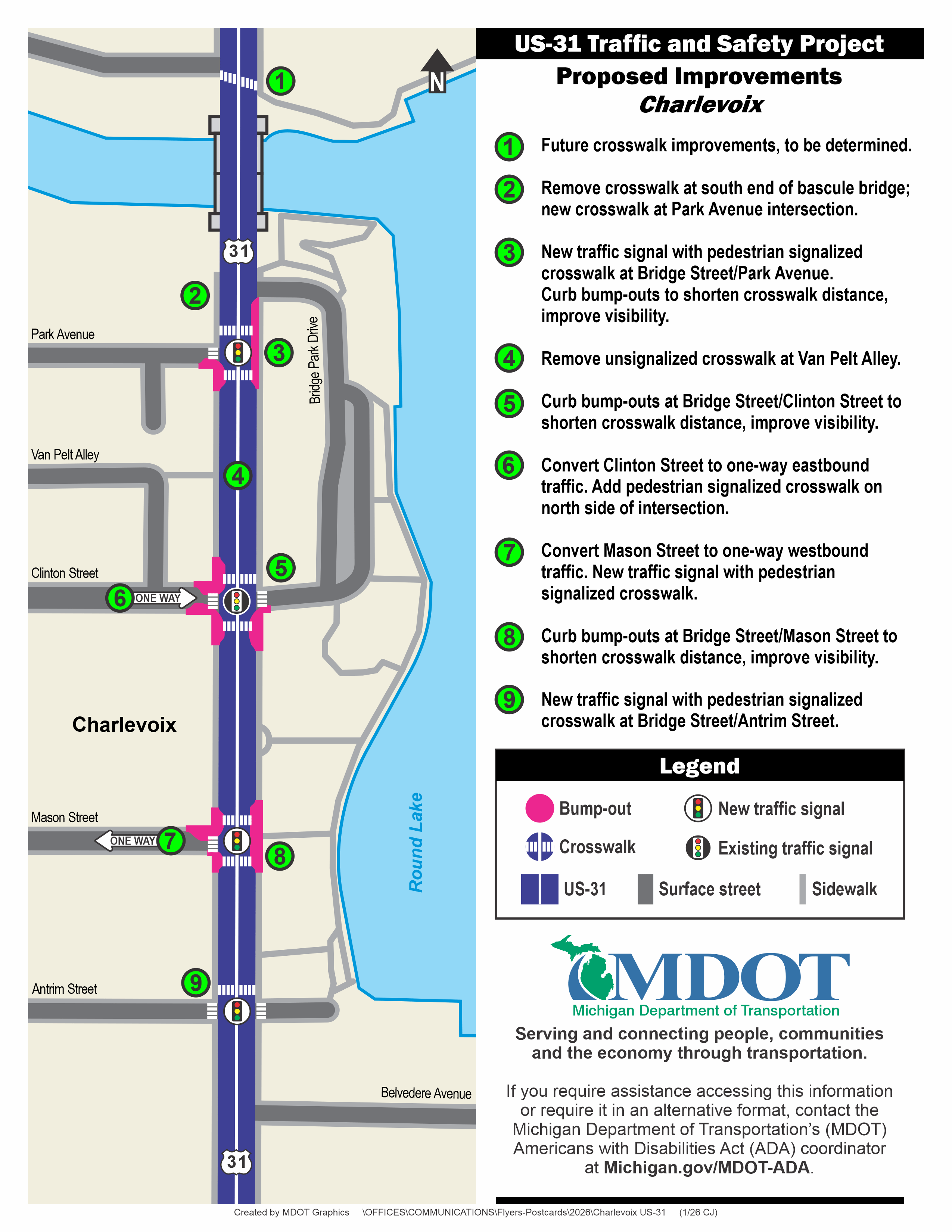
- New traffic signals with pedestrian crossing signals at Antrim Street, Mason Street and Park Avenue.
- The unsignalized mid-block crossing at Van Pelt Alley closes, and that crossing moves to the north side of the Clinton Street intersection.
- The crosswalk on the south side of the bascule bridge closes and moves to the new signal at Park Avenue.
- Mason Street becomes one-way westbound, and Clinton Street becomes one-way eastbound.
- Pedestrian crossings on the north side of the bascule bridge get improvements.
The FAQ adds curb bump-outs at the Mason Street, Clinton Street and Park Avenue intersections. MDOT says they'll make people on foot easier for drivers to see and shorten the distance across.
MDOT says the plan provides "regular and predictable opportunities for drivers to proceed." The bridge gives drivers a forced stop twice an hour. The new signals spread planned stops along the whole downtown stretch, so the people trying to cross get a light to wait for instead of a gap to hope for.
The one-way streets and the Van Pelt crossing
The one-way conversions will change daily routines the most for anyone who uses the blocks off Bridge Street. MDOT says making Mason westbound-only and Clinton eastbound-only will reduce congestion and delays at those intersections.
The Van Pelt Alley crossing was the most-cited visibility problem in the surveys, and it's the one the plan removes. Van Pelt Alley is lined with businesses, including The Cantina at 101 Van Pelt Place. Under the plan, people walking out of the alley toward the far side of Bridge Street will cross at the north side of the Clinton intersection instead.
MDOT is firm that the pieces depend on each other. The project page says the changes "would require the proposed changes to be implemented together, as their benefits are interdependent and won't work as well, or possibly at all, if not put in place holistically." Closing the Van Pelt crossing only works with a signal nearby, and the one-way pair is designed around the new lights at Mason.
Why four lanes aren't coming back
Some survey responses asked MDOT to restore Bridge Street's four lanes. MDOT's answer rests on what happened after the 2018 conversion, when US-31 went to one lane each way with a center left-turn lane from M-66 to Hurlbut Street and from the bascule bridge north to Mercer Boulevard. The Charlevoix City Commission supported that change.
The crash numbers MDOT published make the case:
| Period | Total crashes | Severe-injury crashes |
|---|---|---|
| Three years before the 2018 conversion | 173 | 6 |
| Three years after the conversion | 64 | 3 |
| 2022 to 2024 | 51 | not reported |
That's a 63 percent drop in total crashes and a 50 percent drop in severe-injury crashes, by MDOT's count, and crashes kept declining after that. Because of those results, MDOT says it isn't considering four lanes. The 2027 plan keeps the three-lane layout and changes how people cross it.
MDOT made one other change in 2022. The signals at both ends of the bascule bridge now flash amber instead of showing steady green when the bridge is open to cars, as a reminder to proceed with caution. That change, along with several projects to make the bridge more reliable and cut down on closures from malfunctions, is the background for next spring's work.
The quiet months before spring
From November 1 through December 31, the bridge opens on signal. From January 1 through March 31, a boat needs to give 12 hours' notice. These are the months when Bridge Street runs closest to a normal through street, and they're the last ones under the current layout.
MDOT's schedule for the project is "Spring 2027," at an estimated $2 million. There's no published start date, end date or detour plan yet. For lane closures once work begins, MDOT points drivers to its Mi Drive map. The project page also links a proposed improvements map that shows the changes plotted on the downtown streets.
If you own a home, a storefront or an office on Mason, Clinton or near Van Pelt Alley and want to talk through what a new signal or a one-way street could mean for access, parking and how your property shows to buyers, I'm happy to look at it with you. Davis Labelle is based in Charlevoix and Boyne City. Schedule a free consultation.